
Lenoir County VINE Coverage
North Carolina Statewide Automated Victim Assistance and Notification, or NC SAVAN, is the state’s VINE service. The official network connects North Carolina jails with Adult Correction components, including prison, probation, parole, and community supervision. The North Carolina VINELink portal supports a person search, while 1-877-NC-SAVAN, or 1-877-627-2826, provides telephone access. DAC Victim Support Services is available at 1-866-719-0108.
Coverage depends on the agency and booking path. NC SAVAN does not cover juveniles, police-precinct holding, mental facilities, or people who bond at the magistrate level without being booked. A person released on bail or recognizance at arraignment may also fall outside the custody feed. No result cannot disprove a brief arrest or release. The W.E. “Billy” Smith Detention Center, arresting agency, magistrate, or court record becomes the fallback.
VINE does not provide federal BOP or ICE custody status. A county transfer to a federal agency must be checked with that custodian. It also does not turn the Lenoir County jail’s internal record into a public 24-hour or 72-hour list.
Search Lenoir County VINE Records
Search one person at a time. Begin with the correct state page, then use an offender number if it is known. Names can produce several agency records or several people. A broad spelling may help locate an alias, but a common name is never enough to choose a result. Compare displayed identity details, agency, and offender ID before opening the record.
- Open the North Carolina portal or call NC SAVAN, and confirm the service is set to North Carolina.
- Choose the offender or person search. Enter the name or available offender ID.
- Compare matches by agency and displayed identity information. Do not select solely by name.
- Open the agency-specific result and read custody status, effective date, offender ID, and release or transfer wording.
- If county and DAC entries use separate IDs, inspect each record and register on both when continued notices are needed.
A photo may appear. Treat it as an identity aid, not evidence of release. If the entry says released, compare the time and reason with LCSO, DAC, or the Lenoir County court case. The broader Lenoir County released inmate search path explains how those records fit together.
The official North Carolina VINE search screen shows the statewide entry point used for a Lenoir County lookup.
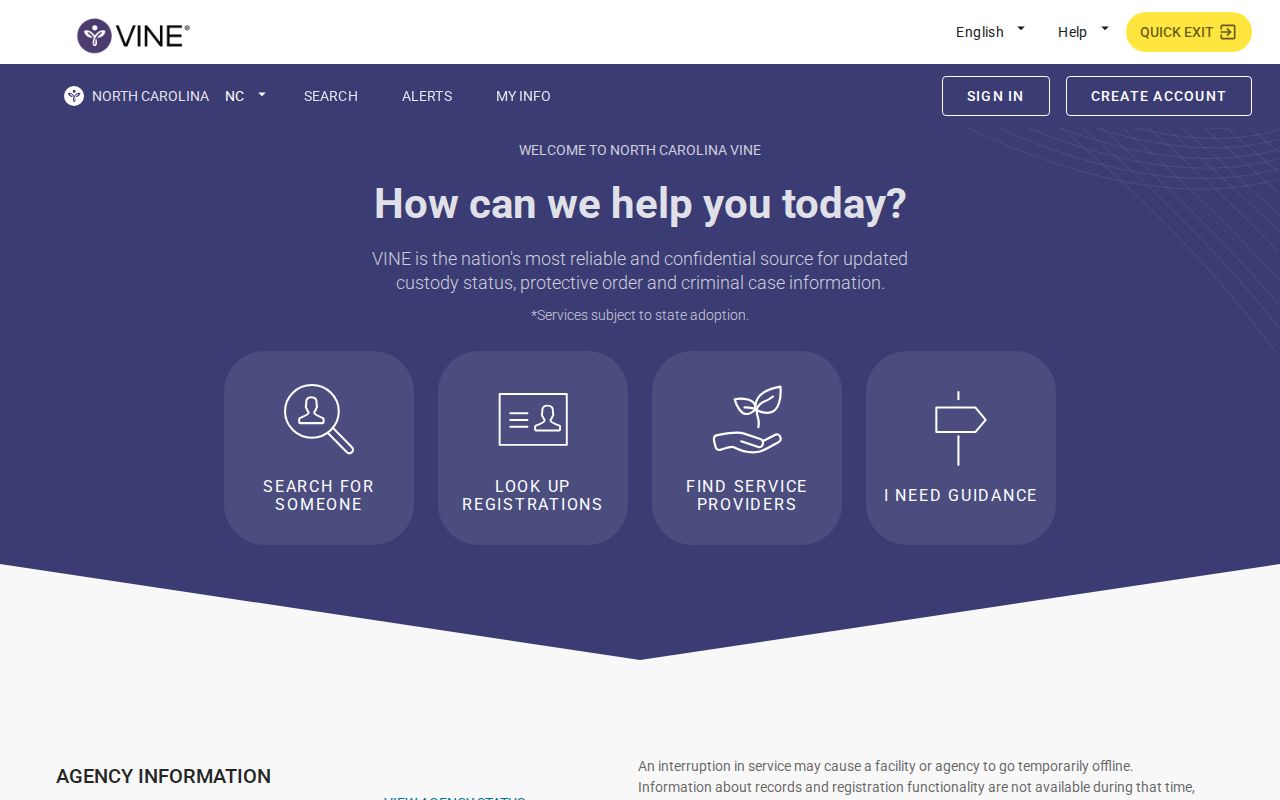
The screen should lead to the correct agency record before any status or notification choice is accepted.
Read Lenoir County VINE Results
Labels can change as the portal updates, so transcribe the live result rather than predicting its wording. A released record commonly gives the reporting agency’s current custody status and the date that status took effect. A transfer-out event can look like departure from a facility without meaning freedom. Read the event, agency, and destination context together.
| Result field | What it helps establish |
|---|---|
| Custody or supervision status | The agency’s current reported state, such as custody, release, or community supervision |
| Status or effective date | When the reported change took effect, subject to agency reporting lag |
| Reporting agency | Whether the record concerns Lenoir County jail custody or a DAC episode |
| Offender ID | The record identity used for searches and notification registration |
| Release or transfer text | The kind of departure reported; transfer does not mean community release |
| Photo, if supplied | An identity aid that does not prove the release event |
When a county and DAC record appear under different IDs, they represent different reporting streams. A jail transfer into state prison may close or change the county entry while the DAC entry begins. That is continued custody. Later, an inactive prison status plus active post-release supervision may mean prison ended but state oversight continues.
Compare a VINE event with the court file when the release basis matters. A bond order may authorize release only after its conditions are met. A dismissal of one charge may leave another hold. A sentence showing time served supports the reason custody should end, but jail staff still process the exit and can encounter another legal process. The VINE timestamp should therefore be read as the agency-reported status event, not as a full account of every court condition.
Lenoir County VINE Event Types
NC SAVAN notices can describe release, transfer, escape, capture, death, and changes in community supervision. Those event names serve different purposes. Release may be with or without supervision. Transfer means the reporting facility gave custody to another custodian. Escape and capture concern an unplanned custody change, while a supervision event can occur after a person has left prison.
For a projected prison release, DAC policy permits notice after the sentence has been audited. The projection can still move when the official sentence calculation changes. A notice recipient should check the current state record on the expected date and look for an Actual Release Date. For a county event, the detention desk can distinguish community release from delivery to another county, DAC, USMS, or ICE.
Telephone retries add urgency but do not make the underlying database infallible. Listen to the entire message, note the agency and offender ID, acknowledge with the PIN, then verify the event through the source named in the call. A screenshot or saved message can preserve wording when a later status update changes the public display.
Set Lenoir County Release Alerts
Registration is tied to the correct person and agency record. It can provide advance notice of release, transfer, escape, capture, death, or a supervision change, depending on the source and options displayed. Registration may be anonymous, and the offender is not told. More than one contact may be enrolled.
- Open the verified person result and choose “Register for Notifications.”
- Select the available event and channel choices, such as phone, text, email, app, or TTY when shown.
- Enter each phone number or email address, and register on every relevant offender ID.
- For phone notices, choose a private four-digit PIN. Email registration does not use that phone PIN.
- Complete the confirmation shown on screen. When a call arrives, enter the PIN to acknowledge it and stop the retry cycle.
- After a transfer, locate the receiving agency record and re-register if the system directs it.
If a PIN is forgotten, the official instructions direct callers to press 0 for help. Critical release, escape, and capture calls can arrive at any time and may repeat every 30 minutes for 24 hours until the PIN is entered. Ordinary notices use a daytime retry pattern. Those attempts show why a reachable phone number and memorable private PIN matter.
NC SAVAN policy also covers projected prison release after sentence audit and release with or without supervision. A projected alert can change. It is a notice to recheck the official sentence and custody record, not a guarantee of the time a person will leave.
Kinston’s NC SAVAN Access
The City of Kinston hosts an official NC SAVAN brochure. That local government source gives Lenoir County residents a direct explanation of county-jail and prison, probation, and parole data. It also explains telephone registration with a four-digit PIN, email registration without a PIN, and the possible use of a photo to distinguish identities.
The Kinston layer is distinctive because it explains the same statewide service in a local public source. It does not create a separate Kinston inmate database. Searches still run through NC SAVAN and VINELink, while each jail or DAC unit supplies its own event data.
Use the brochure to understand registration, then use the correct result to follow the person. Registering on one county ID will not always carry forward after a transfer. The official guidance says a user may need to call and enroll again under the next custodian.
The brochure also notes that email registration does not require the four-digit phone PIN. That difference is useful when choosing channels, but each address or number must still be entered against the right person record. More than one trusted contact can register, and registration itself does not notify the person named in the custody record.
No Lenoir County VINE Result
A blank search can have several causes. The person may have used another spelling, entered custody only recently, remained in police holding, bonded before booking, or fallen within excluded juvenile or mental-facility coverage. It can also mean that the chosen state or agency was wrong. Widen the name carefully and compare all matches before concluding that no record exists.
If the arrest was in Lenoir County, call the detention line and check the eCourts case by name or case number. If LCSO reports a transfer to DAC, search the state offender number. Supported federal or immigration transfers belong in BOP, federal court, USMS, or ICE channels. This custodian-first method prevents a VINE gap from being misread as release.
Confirm Lenoir County VINE Releases
VINE is a notification and status tool, not the final release log. Data originates with participating agencies and can lag the event. A late update, spelling issue, recent booking, unbooked magistrate bond, juvenile case, or police hold can cause an absent or incomplete result. A custody alert should be matched to a direct source when the exact time, reason, or destination matters.
For the county jail, call the Lenoir County Sheriff’s detention line at 252-559-6100 option 2 or the booking desk at extension 6183. Ask whether the movement was community release or transfer and request the processed date and time. For a state prisoner, use the DAC offender search and compare actual release, inmate status, and supervision history.
Federal records require separate paths. The BOP Inmate Locator covers federal prison history, while ICE has its own detainee locator. A USMS pretrial movement may require the federal court or responsible district. NC SAVAN cannot settle any of those federal questions.
Note: Save the reporting agency, offender ID, status wording, and lookup time so a later change can be compared accurately.